Informed Decision-Making
Understand the true structural condition of mature trees before committing to major landscaping or pruning.
Authoritative tree risk assessments, health diagnostics, and development reports by AQF Level 5 arborists.
Consulting arborist services across Jingili and Greater Darwin.
When you need professional documentation for property development, insurance claims, or tree health diagnostics, our arborist report service in Jingili delivers thorough analysis.
Because City of Darwin does not have a private tree permit regime, an arborist report is not a council requirement for routine removals. However, it is the primary way to substantiate tree risk for insurance providers, builders working near root plates, or legal property boundaries.
Understand the true structural condition of mature trees before committing to major landscaping or pruning.
Meet architectural and engineering requirements with clear AS4970 Tree Protection Zone mapping.
Have formal written proof of tree hazards for body corporates, insurers, or adjoining property owners.
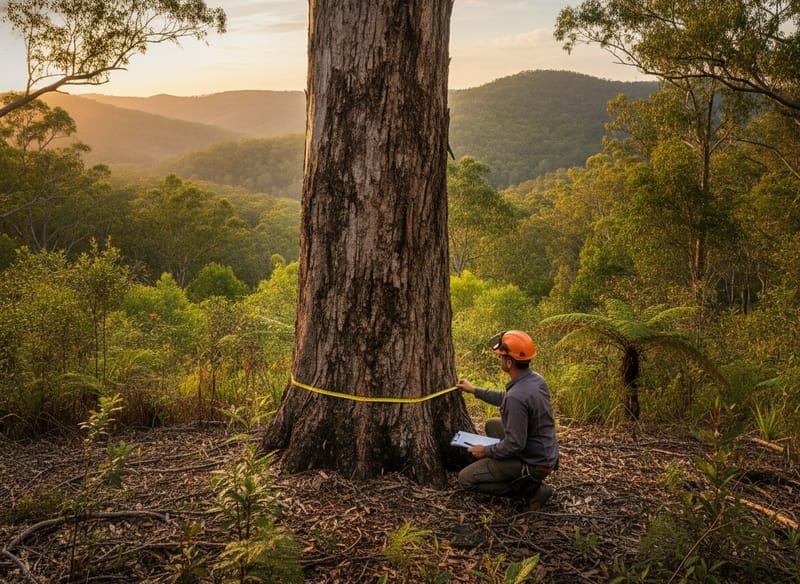
An AQF Level 5 arborist inspects the tree, measuring diameter, canopy spread, and evaluating structural defects.
We evaluate species characteristics, root anchorage in local lateritic soils, and calculate protection zones.
A comprehensive written report is generated, complete with high-resolution photos, findings, and recommendations.
We supply the finalised digital report and discuss practical management steps with you.
Welcome to Darwin Arborist. Whether you are developing a property, managing a strata complex, or assessing storm damage across the northern suburbs, obtaining an accurate, legally recognised Arborist Report Jingili is an essential first step. Darwin's extreme monsoon climate and recent history with severe weather events like Cyclone Fina have reshaped how we manage our urban canopy. With thousands of trees requiring assessment and structural intervention, professional documentation has never been more critical for property owners and managers.
While private residential blocks in the City of Darwin face fewer council tree restrictions than properties down south, formal documentation remains vital for commercial building applications, insurance claims, and duty-of-care risk management. Our team of AQF Level 5 consulting arborists provides comprehensive, independent assessments tailored to our unique Top End environment. From evaluating compromised African Mahoganies on acreage to drafting Tree Protection Plans for new builds near established Darwin Woollybutts, we deliver the definitive data you need. We service Jingili, Moil, Alawa, and the wider Darwin region, providing actionable, scientifically backed arboricultural insights.
Relying on an unqualified contractor or a simple verbal opinion to assess your trees can lead to disastrous financial, legal, and safety consequences. In the Darwin region, our canopy faces intense cyclonic wind loading and aggressive wet-season growth. As we saw during the widespread devastation of Cyclone Marcus and the recent Category 3 Cyclone Fina, many large canopy trees are highly susceptible to failure. This is often driven by balled root systems caused by overwatering, compounded by soil compaction and shallow rooting depths on our local lateritic hardpan.
Without a formal, AQF Level 5 consulting arborist report, property managers and body corporates expose themselves to significant liability if a hazardous tree fails and damages property or injures a resident. For builders and developers, submitting a development application without a compliant Tree Protection Plan can stall your project indefinitely, costing thousands in delays.
Our team solves this by providing rigorous, independent documentation. We conduct detailed Visual Tree Assessments (VTA) to identify structural defects, internal decay, and root zone limitations that an untrained eye simply cannot see. We give you clear, actionable advice on whether a tree can be retained through AS4373-compliant pruning or if it poses an unacceptable risk requiring complete removal. With our detailed reporting, you gain the exact evidence needed to satisfy insurers, protect your assets, and keep your site inherently safe.
We provide a full suite of consulting services, backed by AQF Level 5 qualifications, ensuring your trees are assessed to strict Australian Standards and local planning frameworks.
Comprehensive tree inventories detailing species identification, Diameter at Breast Height (DBH), and Safe Useful Life Expectancy (SULE) ratings. Essential for commercial developments and civil projects to dictate retention strategies.
We map out Structural Root Zones (SRZ) and Tree Protection Zones (TPZ) to safeguard retained native species like Northern Milkwood or Banyan trees during construction. Includes specifications for protective fencing, root mapping, and mulch layers.
Formal hazard evaluations using Visual Tree Assessment methodology. We document physical defects, calculate the likelihood of failure in monsoon conditions, identify target zones, and provide mitigation strategies for schools, strata titles, and public spaces.
Post-storm damage assessments focusing on biomechanical failure analysis. We document whether windthrow was exacerbated by lateritic soil constraints or prior root damage, providing critical evidence for insurance claims and legal disputes.
Detailed reporting to justify the removal of high-risk vegetation. While standard private blocks require no permit, this documentation is heavily utilised by government bodies, body corporates, and acreage owners navigating the Northern Territory Planning Scheme clearing overlays.
Securing an Arborist Report Jingili is a straightforward and transparent process when you work with our experienced team. We handle the technical complexities so you can focus on your property or project.
1. Initial Scoping and Consultation We begin by understanding the exact purpose of your report. Whether you require a risk assessment for a leaning Mango tree threatening a boundary fence or a multi-tree inventory for a townhouse development, we define the scope and provide a fixed-price quote with no hidden fees.
2. On-Site Assessment and Data Collection Our AQF Level 5 arborist attends your Jingili property to conduct a thorough field assessment. We measure trunk diameters, evaluate canopy vitality, assess soil conditions against the local lateritic hardpan, and map out critical root zones. We also photograph structural defects for inclusion in the final document.
3. Analysis and Drafting Back at our office, we compile the field data. We cross-reference your site plans, local topography, and any relevant overlays. Using this data, we draft a highly detailed, professional PDF report featuring clear risk matrices, retention values, and protection guidelines.
4. Handover and Practical Action You receive a finalised, signed document ready for submission to insurers, planners, or stakeholders. If your report mandates hazard reduction or AS4373-compliant structural pruning, our AQF Level 3 climbing crews and heavy-duty chippers are ready to execute the recommended tree work seamlessly.
Every consulting document we produce is authored by an AQF Level 5 Diploma-qualified arborist, ensuring it carries the legal weight required by courts, insurers, and planning authorities. We strictly adhere to AS4970 Protection of Trees on Development Sites when calculating root zones and construction setbacks. When recommending canopy management, all specifications are drafted in accordance with AS4373 Pruning of Amenity Trees, completely eliminating harmful practices like tree topping or lopping. Our business is fully backed by comprehensive public liability and professional indemnity insurance, providing total peace of mind when you rely on our professional arboricultural advice.
Assessing trees in the Top End requires deeply specialised local knowledge. Jingili and the surrounding suburbs sit on lateritic red soil over a restrictive hardpan, which severely limits deep root growth. When paired with our extreme wet seasons and intense cyclonic wind loading, large exotics like African Mahogany often develop dangerous, shallow root plates. Understanding these specific biomechanical failures is critical to providing accurate Safe Useful Life Expectancy (SULE) ratings.
Unlike southern cities, the City of Darwin does not operate a private tree permit system or a significant tree register for suburban blocks. By-law 102 protects vegetation on council land, while By-law 103 actually compels owners to trim vegetation overhanging public roads and verges. Therefore, while you don't need a permit to remove a tree in a standard Jingili backyard, formal arborist reports remain highly sought after by strata managers navigating duty of care, and by acreage owners on the outskirts dealing with the Northern Territory Planning Scheme's native vegetation clearing overlays.
Once your report is finalised, prompt implementation is key to reducing liability. If we have supplied a Tree Protection Plan, ensure all protective fencing and mulch layers are physically installed before any earthmoving machinery enters your site. For hazard assessments that recommend weight reduction, crown thinning, or deadwooding, it is vital that the physical work is executed by our AQF Level 3 climbing arborists to ensure compliance with AS4373. For high-risk targets like schools or large commercial complexes, we highly recommend scheduling an annual visual reassessment prior to the wet season, or following any severe cyclonic weather.
Arborist report costs reflect the level of qualification required, the number of trees assessed, and the report scope.
We provide transparent, fixed-price quotes for all consulting arborist reports prior to attending site.
Providing consulting arborist reports across Jingili and Greater Darwin.
Get in touch with our AQF Level 5 consulting arborists for professional tree assessments and reports.
Request an Arborist Report