Legal & Insurance Certainty
Support insurance claims and liability disputes with independent, defensible scientific findings.
Comprehensive, legally robust tree reports compiled by qualified AQF Level 5 consulting arborists in Woolner.
Delivering consulting arborist reports across Woolner and greater Darwin.
When you need professional documentation regarding tree health, safety, or planning compliance, a formal arborist report Woolner provides authoritative, independent evidence.
While City of Darwin does not require private removal permits for residential blocks, formal arborist reports are frequently needed in Woolner for commercial developments, insurance claims following cyclone events, and complex boundary asset disputes.
Support insurance claims and liability disputes with independent, defensible scientific findings.
Meet architectural, engineering, and planning conditions with AS4970-compliant tree management plans.
Gain a clear, unbiased understanding of tree health before investing in costly maintenance or construction.
Our AQF Level 5 arborist conducts a comprehensive on-site Visual Tree Assessment (VTA).
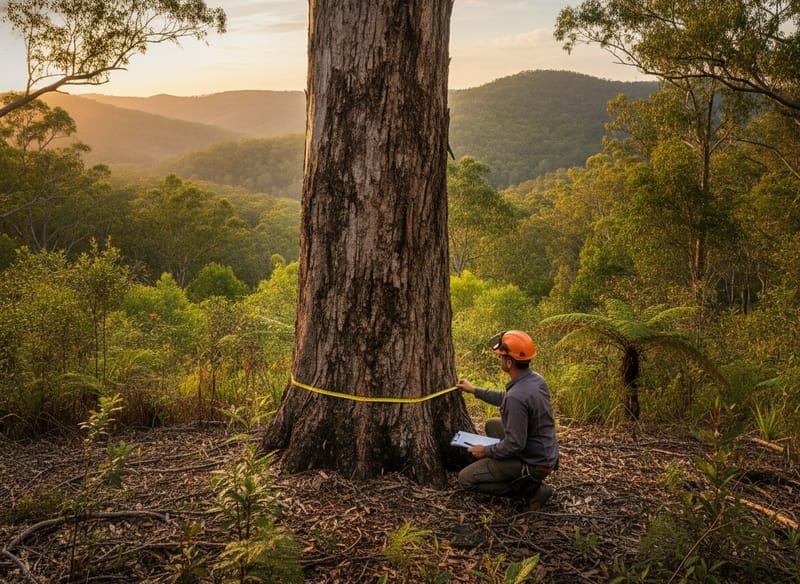
We record trunk diameter (DBH), height, canopy spread, defect zones, and soil conditions.
We calculate TPZ, SRZ, risk ratings, and evaluate findings against relevant Australian Standards.
You receive a formal, high-resolution PDF report complete with photos, diagrams, and recommendations.
Living in the Top End means managing significant wet season risks, and securing a professional Arborist Report Woolner is the best way to understand and mitigate those hazards on your property. Whether you are managing an established residential block, planning a new development, or dealing with the aftermath of recent severe weather, our AQF Level 5 consulting arborists provide the documented clarity you need. Woolner properties often feature large, fast-growing shade trees that require professional assessment to ensure structural integrity. While the City of Darwin does not mandate reports for routine removals on standard private suburban land, having a formal, independent assessment is critical for insurance claims, neighbour disputes, body corporate duty-of-care, and construction planning. We deliver comprehensive, legally sound documentation that takes the guesswork out of your tree management. From diagnosing root plate decay in waterlogged soils to specifying protection zones for site works, our team ensures your property remains safe, compliant, and prepared for the monsoon season.
A common mistake property owners make is relying on a verbal opinion from an under-qualified tree lopper instead of a formal assessment from a certified consulting arborist. When disputes arise, or when an insurance claim requires evidence of a tree's pre-storm condition, an undocumented or informal opinion carries absolutely no weight. Without an AQF Level 5 qualification, the advice you receive may not hold up under legal, structural, or council scrutiny.
Furthermore, poor advice often leads to unnecessary removals or, worse, retaining a highly hazardous tree. In Darwin's harsh monsoonal climate, failing to accurately identify root plate decay, lateritic hardpan restriction, or poor branch attachments can have devastating consequences when cyclone season arrives. An unqualified assessor might miss the warning signs of a compromised structural root zone, leaving your home or commercial asset exposed to sudden failure.
Our team solves this by providing rigorous, evidence-based reports. We conduct detailed Visual Tree Assessments (VTA) and apply industry-standard methodologies to evaluate the true health and risk profile of your canopy. By engaging us, you receive a highly detailed, AS4373 and AS4970 compliant document that protects your liability, satisfies insurers, and provides a clear, actionable roadmap for your property.
Our consulting arboriculture services utilise industry-leading methodologies to provide accurate, evidence-based documentation for various legal, structural, and developmental requirements across Darwin.
The foundational diagnostic process used by our AQF Level 5 arborists. We systematically inspect the crown, trunk, and root flare for signs of decay, fungal fruiting bodies, and structural defects, assessing both the likelihood and consequence of failure.
Essential for construction and subdivision projects. We map out Tree Protection Zones (TPZ) and Structural Root Zones (SRZ) in accordance with AS4970, dictating how retained trees must be protected from excavation, root severing, and soil compaction during building works.
Formal documentation of hazard levels, particularly critical for commercial properties, body corporates, and schools in Woolner. We evaluate target zones (pedestrians, buildings, parking) and recommend specific risk mitigation strategies, ranging from canopy weight reduction to complete removal.
Detailed post-storm assessments, heavily utilised following severe weather events like Cyclone Fina. We document the exact mechanism of failure, identify any pre-existing structural defects, and provide the expert evidence required to process complex insurance claims.
Securing a professional assessment begins with a direct consultation. When you contact our team, we first clarify the exact purpose of the report—whether it is for a pre-purchase property inspection, a post-storm insurance claim, a boundary dispute, or a construction site tree protection plan.
Next, our AQF Level 5 consulting arborist will visit your Woolner property to conduct a thorough site inspection. We measure the Diameter at Breast Height (DBH), assess canopy vitality, inspect for structural flaws, and evaluate the surrounding soil profile, particularly checking for lateritic hardpan restrictions. We take detailed photographic evidence and precisely map the location of the specimens in question relative to existing structures.
Once the field data is collected, we move to the analysis and drafting phase. We cross-reference our findings with relevant Australian Standards, including AS4970 for development sites and AS4373 for pruning recommendations. The data is compiled into a highly detailed, peer-reviewable PDF document outlining condition, risk rating, and life expectancy.
Finally, we deliver the completed report to you, complete with clear, actionable recommendations. If the report advises specific weight reduction to AS4373 standards or complete removal due to structural hazard, our AQF Level 3 climbing arborists can then be engaged to execute the required works safely.
All our consulting work is spearheaded by arborists holding an AQF Level 5 Diploma of Arboriculture, which is the required standard for formal reporting, development assessments, and legal risk documentation in Australia. We are fully insured, carrying comprehensive Public Liability and Professional Indemnity insurance, ensuring that the advice you receive is backed by robust financial protection.
Our reporting frameworks strictly adhere to AS4970-2009 Protection of Trees on Development Sites and AS4373-2007 Pruning of Amenity Trees. While the City of Darwin does not heavily regulate private residential tree removal, our adherence to these national standards guarantees that your documentation meets the rigorous expectations of insurers, courts, civil engineers, and commercial property managers.
Woolner's urban landscape is heavily influenced by the Top End's extreme weather and unique soil profiles. Darwin sits on lateritic red soil featuring a gravelly surface over poorly structured sandy clay, terminating in a hardpan that severely restricts deep root growth. This mechanical barrier results in shallow root plates that are highly susceptible to windthrow when the ground becomes waterlogged during the wet season. Recent severe weather events, particularly Cyclone Fina and Cyclone Marcus, have highlighted the vulnerability of specific species. African Mahogany (Khaya senegalensis) trees planted decades ago have proven structurally unreliable due to these shallow roots and massive, rapid canopy growth. Our reports frequently address these legacy plantings, advising on proactive risk management and removal before the monsoon arrives. While City of Darwin by-laws strictly protect vegetation on council land and verges, private suburban blocks in Woolner operate without a restrictive tree preservation order. This means an arborist report here is less about council permits and entirely about managing genuine hazard, ensuring structural integrity, and documenting liability for your assets.
An arborist report is only as valuable as the actions you take following its delivery. Once you receive your documentation, review the retention recommendations and risk mitigation strategies carefully.
If the report highlights compromised branch attachments or specifies a required canopy reduction, schedule the remedial pruning promptly before the wet season sets in. For development sites, ensure the specified Tree Protection Zone (TPZ) fencing is erected exactly as outlined before any heavy machinery arrives on site. Keep our team's contact details handy; we recommend scheduling a follow-up visual inspection every two to three years for mature, high-retention-value species like native Milkwoods or Banyan trees to monitor their ongoing structural health and vitality.
Arborist report fees in Woolner vary depending on the scope of the assessment, tree count, and reporting level.
We provide fixed-price quotes for all consulting arborist reports with clear deliverables and turnarounds.
We provide consulting arborist reports across Woolner and all Darwin suburbs.
Contact our consulting team for independent tree risk assessments and development reports.
Get a Free Quote